
Blogs & Articles
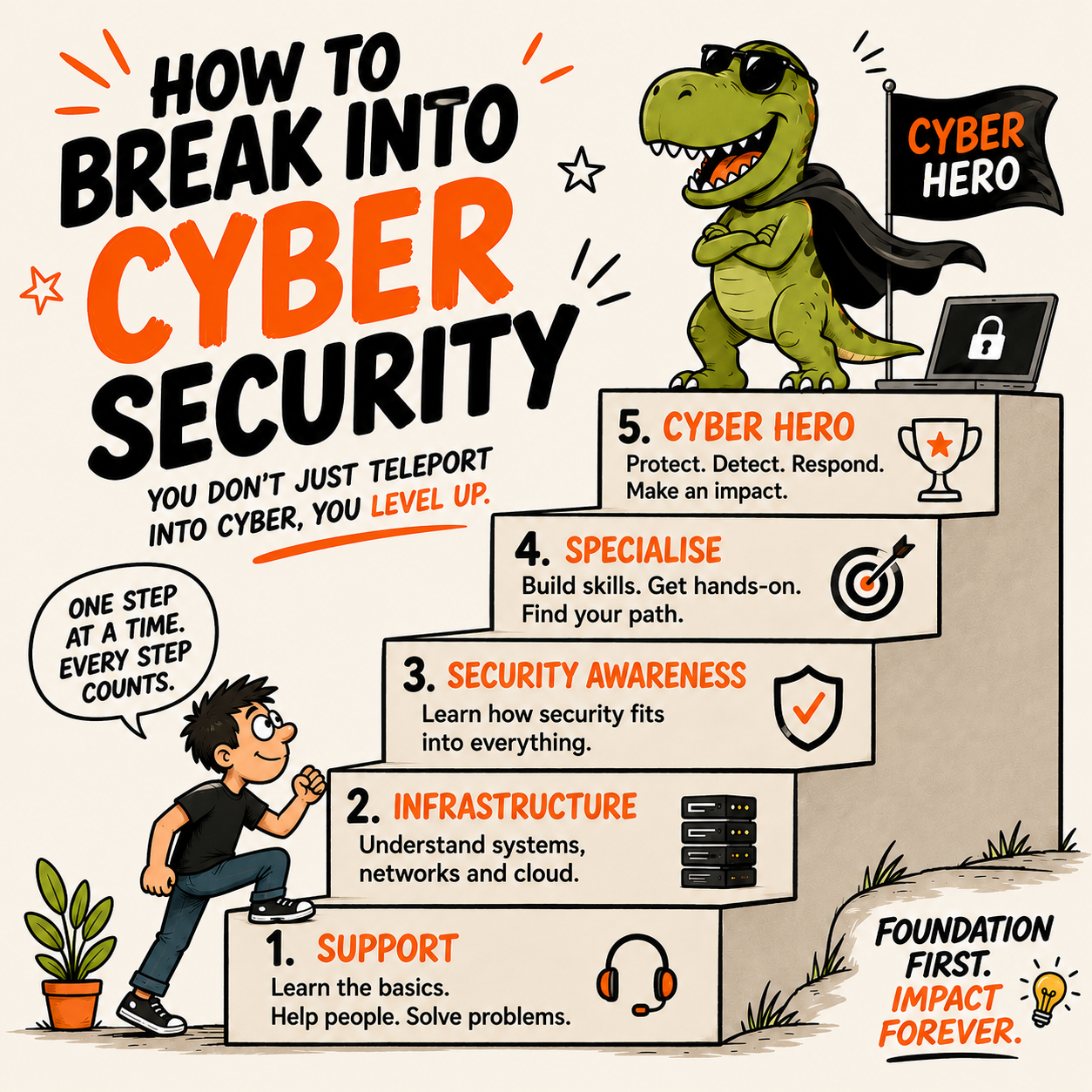
Cybersecurity is one of the most exciting, fast-moving and potentially rewarding areas of IT right now. It’s also one of the most misunderstood when it comes to actually building a career. There’s a huge amount of messaging suggesting that if you complete the right certification, finish a cyber degree, build a home lab and learn a few security tools, you can walk straight into a cybersecurity role. And sometimes you can. Some people land that SOC Analyst opportunity straight out of university. Others meet the right employer at exactly the right time, secure a junior security position and never look back. But for many people, the journey looks very different. And that’s perfectly OK. In fact, some of the best cybersecurity careers start somewhere far less glamorous. The service desk. You spend time troubleshooting Microsoft 365, resetting accounts, learning Active Directory and Entra ID, understanding permissions, networking, endpoints, servers and cloud infrastructure. You also discover the mysterious ability users have to break things nobody previously thought were breakable. 😄 It might not feel like cybersecurity at the time, but you’re building something incredibly important – context . You’re learning how technology actually works inside a business. You see how users behave, how identities are managed, where permissions go wrong, why systems fail, how networks communicate and how seemingly small configuration mistakes can create much bigger problems. Then perhaps you progress into L2 support, infrastructure, systems administration, networking or cloud. Gradually, security becomes part of almost everything you do. Identity, MFA, Conditional Access, endpoint security, firewalls, vulnerability management, email security, privileged access, patching and incident response. Suddenly, you’re not just studying cybersecurity. You understand the technology you’re trying to secure. And that foundation can be incredibly valuable. Another misconception is that "getting into cyber" means getting one particular job, usually a SOC Analyst role. But cybersecurity is enormous. There are careers in security operations, security engineering, IAM, cloud security, governance and risk, penetration testing, vulnerability management, security architecture, incident response, threat intelligence and many other areas. You don’t necessarily need to teleport from the service desk into a SOC. You can level up into cybersecurity. A systems engineer working heavily with Entra ID, Conditional Access and privileged access might eventually specialise in IAM. A cloud engineer might move into cloud security. A network engineer could move towards network security. An infrastructure engineer who becomes increasingly involved in security projects could transition into security engineering. Cybersecurity doesn’t always have to be a dramatic career change. Sometimes it’s simply the next stage of your technical career. Certifications, degrees, home labs and courses absolutely have value. They demonstrate learning and show employers you’re serious about developing your skills. But they become far more powerful when combined with genuine hands-on experience. If you’re trying to build a cybersecurity career and the direct route isn’t opening up yet, focus on a few things: Build strong IT foundations – networking, infrastructure, identity, cloud and endpoints. Find security inside your current role – volunteer for security projects, audits, migrations and remediation work. Combine certifications with practical experience – learn the theory, then find ways to actually use it. Build relationships with people already working in cyber – understand how they got there and what employers actually value. Look sideways as well as upwards – IAM, cloud security, security engineering and other areas can provide excellent transition points. Most importantly, don’t think of time spent in support, infrastructure, networking or cloud as time wasted because you haven’t officially "made it into cyber" yet. It could be exactly what makes you better when you do. Cybersecurity needs people who understand security, but it also needs people who understand systems, infrastructure, cloud, networks, users and businesses. The more you understand how all those pieces fit together, the better equipped you can become to protect them. There are multiple ways into cybersecurity. Occasionally somebody gets to skip a few steps. For everyone else, those steps aren’t necessarily obstacles. They can become the foundations of a fantastic career. So don’t become obsessed with getting into cybersecurity as quickly as possible. Become obsessed with building a cybersecurity career that will last. 🔐 Want more FREE content around building culture and hiring? 👉 https://jmp.sh/Blgq4f8A Want more FREE content around career development and job seeking? 👉 https://jmp.sh/gla70YWp Some great videos here as well 👉 https://www.youtube.com/playlist?list=PLWCIjFeFwvnmiULvInFNx2IkTuwtYxqsy
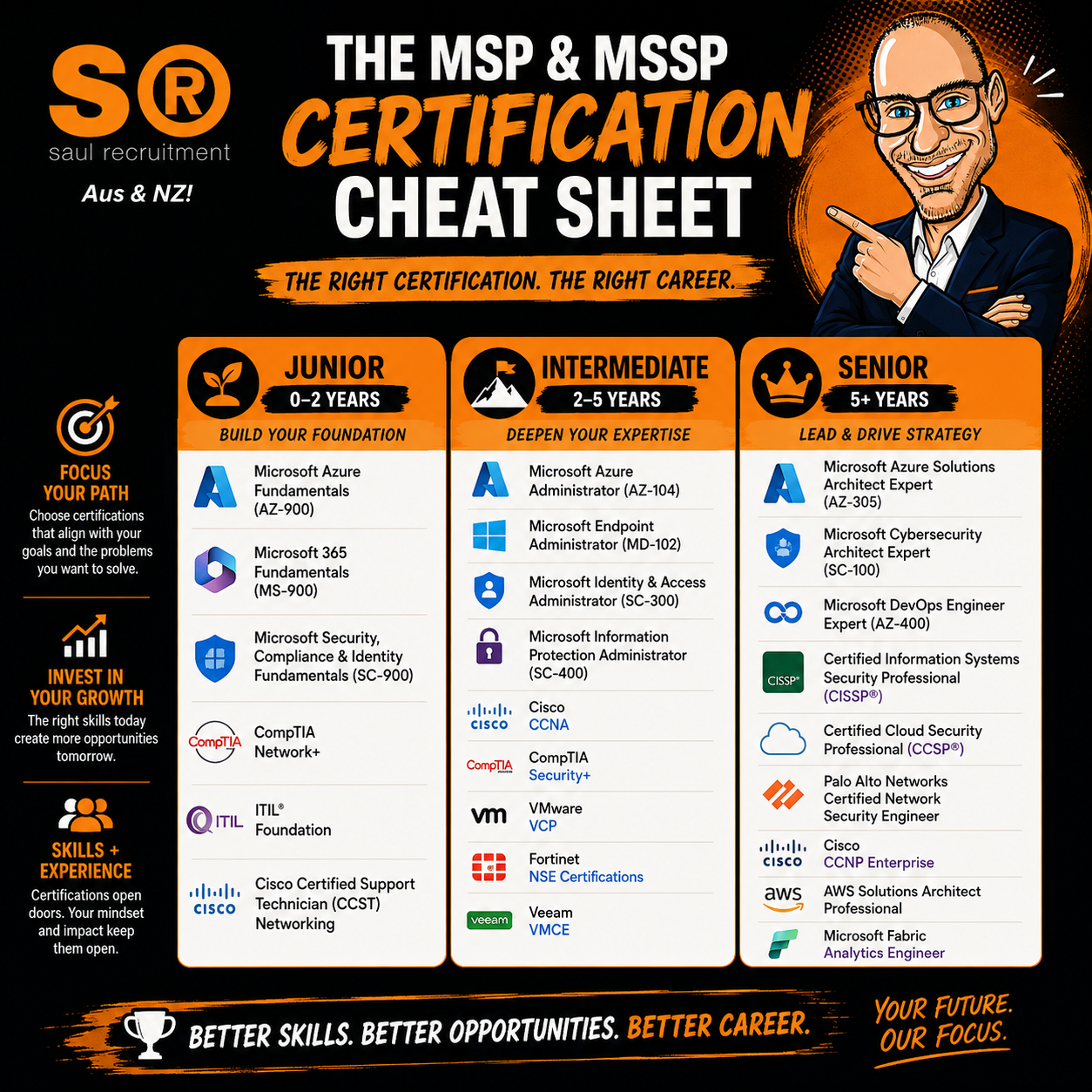
One of the questions I get asked most often by engineers is, "Which certification should I do next?" The answer is usually the same. It depends on where you are in your career. Too many people collect certifications because they look impressive on LinkedIn. The best engineers use certifications to build practical skills that solve real business problems. MSPs and MSSPs are evolving rapidly. Cloud, identity, automation, cybersecurity and AI are reshaping the services clients expect. The engineers who continue investing in the right skills will have the greatest opportunities over the next five years. Here's where I believe your focus should be. Junior Engineers (0–2 Years) At this stage, the goal isn't to become an expert. It's to build a solid technical foundation while demonstrating that you're committed to learning. Some of the most valuable certifications include: Microsoft Certified: Azure Fundamentals (AZ-900) Microsoft 365 Fundamentals (MS-900) Microsoft Security, Compliance & Identity Fundamentals (SC-900) CompTIA Network+ ITIL Foundation Cisco Certified Support Technician (CCST) Networking These certifications introduce cloud computing, networking, Microsoft technologies and IT service management. More importantly, they help junior engineers understand how modern MSPs operate. Intermediate Engineers (2–5 Years) This is where careers often accelerate. Clients expect engineers to solve problems independently, deliver projects and provide technical advice. Certifications should now deepen technical capability rather than simply demonstrate awareness. I'd recommend focusing on: Microsoft Azure Administrator (AZ-104) Microsoft Endpoint Administrator (MD-102) Microsoft Identity and Access Administrator (SC-300) Microsoft Information Protection Administrator (SC-400) Cisco CCNA CompTIA Security+ VMware VCP Fortinet NSE certifications Veeam VMCE These certifications align closely with what many MSPs and MSSPs are delivering every day, including Microsoft 365, Azure, networking, endpoint management, backup and cybersecurity. Senior Engineers & Technical Leaders (5+ Years) Senior engineers are expected to design solutions, mentor teams and advise clients strategically. At this level, certifications should reflect architecture, security and leadership. Some of the strongest options include: Microsoft Azure Solutions Architect Expert (AZ-305) Microsoft Cybersecurity Architect Expert (SC-100) Microsoft DevOps Engineer Expert (AZ-400) Certified Information Systems Security Professional (CISSP) Certified Cloud Security Professional (CCSP) Palo Alto Networks Certified Network Security Engineer Cisco CCNP Enterprise AWS Solutions Architect Professional Microsoft Fabric Analytics Engineer (where data projects are becoming part of managed services) These certifications prepare engineers to lead complex cloud migrations, security transformations and strategic client engagements. Don't Chase Every Badge One mistake I see regularly is engineers collecting certifications that don't align with the work they actually want to do. Instead, ask yourself: What problems do I want to solve? What projects do I want to lead? What role do I want in three years? Your certification roadmap should support those answers. The Skills That Matter Most The best engineers I've placed don't always have all the certifications. And my clients still fight over them. They hire people who can communicate with customers, simplify complex technology, document their work, collaborate with teammates and genuinely enjoy solving problems. Technical certifications might get you the interview. Your attitude, curiosity and ability to deliver outcomes are what build a long-term career. Invest in both, and you'll always be in demand. Want more FREE content around building culture and hiring? 👉 https://jmp.sh/Blgq4f8A Want more FREE content around career development and job seeking? 👉 https://jmp.sh/gla70YWp Some great videos here as well 👉 https://www.youtube.com/playlist?list=PLWCIjFeFwvnmiULvInFNx2IkTuwtYxqsy

When most businesses think about cybersecurity, their first instinct is to invest in more technology. A new firewall. A more advanced EDR platform. A better email security solution. An AI-powered SOC. Those investments absolutely matter, but they often overlook the biggest vulnerability in almost every organisation - people. After years of working with the MSP and MSSP market, I've noticed something interesting. The organisations with the strongest security posture aren't always the ones with the biggest technology budgets. They're the ones that have built a security-first culture where every employee understands their role in protecting the business. They recognise that cybersecurity isn't just an IT responsibility - it's a business responsibility. Think about how many breaches still begin with something surprisingly simple. Someone clicks a phishing email. A password gets reused. Multi-factor authentication is ignored. Sensitive data is shared without thinking. An employee grants access to someone they shouldn't. In most cases, the technology didn't fail. Human behaviour created the opportunity. That's why the role of an MSSP is changing. It's no longer enough to deploy security tools and respond to alerts. The most valuable MSSPs help clients build a security culture where every employee understands that cybersecurity is part of their job. They educate, challenge assumptions, improve processes and encourage behaviours that reduce risk long before an attack occurs. The real value isn't simply detecting threats - it's helping businesses create fewer opportunities for attackers in the first place. The businesses getting cybersecurity right understand that technology alone isn't enough. They create environments where people feel comfortable reporting suspicious emails, admitting mistakes and asking questions without fear of blame. They know that a well-informed employee can be just as valuable as the latest security platform because awareness and good decision-making prevent incidents before they ever reach the SOC. If you want to strengthen your organisation's security posture, it's worth asking a few important questions: - Is cybersecurity discussed outside the IT team? - Are employees regularly educated, or just once a year? - Do leaders model good security behaviours themselves? - Are people encouraged to report mistakes quickly without fear? - Are we investing in our people as much as we're investing in technology? Technology will continue to evolve. Attackers certainly will. But the organisations that will stay ahead are the ones that understand cybersecurity is ultimately about people. When every employee understands their role in protecting the business, security stops being another compliance exercise and becomes part of the company's culture. And that's something no software alone can ever replace. Want more FREE content around building culture and hiring? 👉 https://jmp.sh/Blgq4f8A Want more FREE content around career development and job seeking? 👉 https://jmp.sh/gla70YWp Some great videos here as well 👉 https://www.youtube.com/playlist?list=PLWCIjFeFwvnmiULvInFNx2IkTuwtYxqsy

After 25 years in recruitment, one thing has become incredibly obvious to me. The candidates who consistently create the best career outcomes are not always the most technically gifted people in the market. They are not always the candidates with the most certifications, the strongest CVs, or the longest list of achievements. In many cases, the people who progress the fastest and position themselves most effectively are simply the people who understand how to build strong professional relationships with recruiters. That distinction matters more than many candidates realise. Too often, candidates approach recruiters in a very transactional way. The process becomes little more than sending a CV and waiting for updates. When communication slows down or opportunities do not immediately appear, frustration builds quickly. Many candidates begin to feel recruiters are unresponsive, unclear, or not genuinely invested in helping them. But the reality is that recruitment works far better when it becomes a partnership rather than a passive process. The strongest candidates understand that good recruiters can offer far more than access to jobs. A quality recruiter can provide valuable market insight, salary benchmarking, interview preparation, career positioning advice, feedback from employers, and visibility into opportunities that may never be advertised publicly. Recruiters often understand the hiring market at a deeper level than candidates do because they spend every day speaking with businesses, hiring managers, technical leaders, and other professionals across the industry. This creates a level of perspective that can be incredibly valuable for candidates who are serious about building their careers strategically rather than emotionally reacting to opportunities as they appear. One of the biggest misconceptions candidates have is believing a recruiter’s role is simply to “find them a job”. In reality, the best recruiters operate more like career partners and market advocates. They help candidates position themselves more effectively, understand how they are perceived by employers, identify gaps in presentation or communication, and often guide them towards opportunities they may never have considered on their own. However, recruiters can only do this effectively when candidates engage properly in the process. The candidates who achieve the strongest outcomes are usually the ones who communicate clearly, consistently, and professionally. They provide context around what they want from their careers. They are transparent about salary expectations, motivations, competing opportunities, and concerns. They respond promptly, stay engaged throughout interview processes, and remain open to constructive feedback. That last point is incredibly important. Many candidates struggle with feedback because they view recruitment emotionally rather than strategically. But honest feedback is one of the most valuable parts of working with an experienced recruiter. Sometimes a candidate’s technical capability is not the issue at all. Sometimes it is communication style, interview preparation, presentation, confidence, unrealistic expectations, or simply positioning themselves incorrectly in the market. Good recruiters often see patterns candidates cannot see themselves. After thousands of interviews and conversations over many years, experienced recruiters become very good at identifying what employers respond positively to and what quietly creates hesitation during hiring decisions. Candidates who listen carefully to this feedback often improve dramatically over time. Interestingly, the behaviours that create strong recruiter relationships are often the exact same qualities employers are looking for when hiring. Strong communication. Responsiveness. Professionalism. Reliability. Self-awareness. Commercial maturity. These qualities become visible long before a candidate officially starts a role. The way someone manages communication during a recruitment process often says a great deal about how they will operate inside a business. Candidates who communicate well, prepare properly, follow through on commitments, and engage professionally naturally create stronger impressions with both recruiters and employers. A Few Simple Ways Candidates Can Build Better Recruiter Relationships Be clear about what you actually want from your next role Respond promptly, even if it is just a quick update Be transparent about salary expectations and other interview processes Stay engaged throughout the recruitment journey Be open to honest feedback and coaching Treat recruiters professionally, even when opportunities are not the right fit Ask thoughtful questions instead of waiting passively for updates Keep long-term relationships in mind, not just immediate outcomes Another important reality many candidates overlook is that recruiters build long-term networks and long-term memories. Recruitment is a relationship-driven industry. Recruiters remember candidates who communicate well, show professionalism, and build genuine rapport over time. Those relationships often create future opportunities years later when new roles, projects, or leadership positions emerge. The opposite is also true. Candidates who disappear mid-process, communicate poorly, exaggerate information, or treat recruiters disrespectfully often damage opportunities without realising it. In a highly connected professional market, reputation matters more than people think. The most successful professionals understand that careers are rarely built through isolated transactions alone. They are built through relationships, reputation, consistency, communication, and trust developed over long periods of time. After 25 years in this industry, I genuinely believe candidates who learn how to partner effectively with recruiters place themselves in a significantly stronger position over the long term. They gain better market visibility, stronger career guidance, more strategic opportunities, and often build networks that continue supporting them throughout different stages of their careers. The recruitment process should never feel like “send CV and hope”. The strongest outcomes usually happen when candidates become active participants in the process, build genuine professional relationships, and recognise the value that experienced recruiters can bring beyond simply forwarding resumes. Because the best candidates do not simply “use” recruiters. They partner with them. Want more FREE content around building culture and hiring? 👉 https://jmp.sh/Blgq4f8A Want more FREE content around career development and job seeking? 👉 https://jmp.sh/gla70YWp Some great videos here as well 👉 https://www.youtube.com/playlist?list=PLWCIjFeFwvnmiULvInFNx2IkTuwtYxqsy

The MSP/MSSP talent market across Australia and New Zealand has evolved. Not dramatically on the surface - but meaningfully beneath it. What was once a fast-moving, salary-driven market has become more measured, more selective, and more experience-led. Importantly, this shift is not limited to hiring. The same factors influencing how professionals choose employers are now influencing how clients choose partners. The organisations recognising this overlap are the ones gaining a competitive advantage - both in attracting talent and securing new business. Salary - Stabilisation has shifted the value conversation Salary growth has stabilised following the post-COVID surge, with most increases now sitting around 5% rather than the aggressive jumps seen previously. For MSP/MSSPs operating within 20–30% margins, competing purely on salary has always been challenging. This has led to a broader shift in how value is defined. Clients are now applying similar thinking. While cost remains important, it is no longer the sole driver. Increasingly, organisations are prioritising providers who can demonstrate measurable outcomes, reliability, and long-term value. The conversation has moved from price to impact. Work From Home - Flexibility as a reflection of maturity Hybrid work is now firmly established and, for many professionals, expected rather than optional. While MSP/MSSP environments often require a degree of onsite presence, the expectation for flexibility remains strong. This has broader implications. Flexible, well-structured internal environments tend to produce more responsive, adaptable and engaged teams. In turn, this translates into a more consistent and client-focused service experience. Operational flexibility internally often signals service flexibility externally. Workload & Burnout - A signal of operational maturity Workload remains a critical factor, with on-call fatigue, ticket volume and 24/7 expectations continuing to shape perceptions of MSP environments. Professionals are increasingly assessing escalation paths, documentation standards and overall operational structure before making decisions. Clients are doing the same. They are evaluating whether a provider operates with clarity and structure or relies on reactive processes. Consistency, predictability and reliability are now key decision drivers. Internal pressure points often manifest externally as service inconsistency. Culture & Leadership - From internal priority to commercial advantage Leadership has become one of the strongest drivers of retention, engagement and performance. Teams are evaluating leadership quality, communication, and the presence of clear progression pathways. From a client perspective, these same attributes translate into trust. Clear leadership, structured communication and accountable delivery provide confidence. In a competitive market, this confidence often becomes a deciding factor in awarding work. Skills Shift - From reactive support to measurable impact There is a continued shift towards professionals who contribute beyond reactive support, with increasing demand for cloud, security, automation and AI capabilities. This reflects a broader change in client expectations. Organisations are no longer seeking providers who simply resolve issues. They are looking for partners who can proactively improve environments, reduce risk and support future growth. MSPs that align their capability and messaging with these outcomes are better positioned to differentiate and win higher-value work. Training & Development - A retention lever and a commercial signal Training has moved from a benefit to a strategic differentiator, particularly when supported by dedicated time and structured development pathways. This has a direct commercial impact. Well-developed teams are more confident, more capable in client interactions, and more effective in delivering solutions. This enhances both service quality and client trust. Investment in people is increasingly visible to clients - and influences their perception of capability. Documentation, Tooling & Structure - Reducing perceived risk Documentation and tooling are no longer purely internal considerations. They are indicators of how effectively an organisation operates. Strong documentation, automation and structured processes reduce reliance on individuals and create consistency. From a client perspective, this reduces risk. In a market where organisations are more cautious in decision-making, MSPs that demonstrate structure and maturity are more likely to be selected over those competing primarily on price. The bigger picture Salaries have stabilised. Flexibility is expected. Workload tolerance is lower. Culture and leadership carry greater weight. Development is essential. And movement in the market is more selective and deliberate. The key insight is this: The factors that attract and retain talent are increasingly the same factors that attract and retain clients. What this means for MSP/MSSP sales and marketing This shift is changing how MSPs need to position themselves in the market. Lead with outcomes, not features - Talk about risk reduction, uptime improvement, security posture and business continuity, not just tools and SLAs Show your structure - Demonstrate how you operate: escalation paths, documentation standards, proactive processes and governance Make your team visible - Highlight expertise, certifications, development pathways and how your people engage with clients Prove consistency - Use case studies, client stories and real examples that show reliability over time, not just one-off wins Align marketing with reality - The internal experience you create for your team should match the external experience you promise clients Final thought The MSP/MSSP market is no longer defined by speed or urgency. It is defined by experience, structure and trust. The organisations that will perform best in this environment are not those that offer the most, but those that operate with clarity, develop their teams consistently, and deliver a reliable, high-quality experience. In this market, capability opens the door - but credibility and consistency are what ultimately secure the work. Want more FREE content around building culture and hiring? 👉 https://jmp.sh/Blgq4f8A Want more FREE content around career development and job seeking? 👉 https://jmp.sh/gla70YWp Some great videos here as well 👉 https://www.youtube.com/playlist?list=PLWCIjFeFwvnmiULvInFNx2IkTuwtYxqsy

Because money isn’t why your top talent leaves..